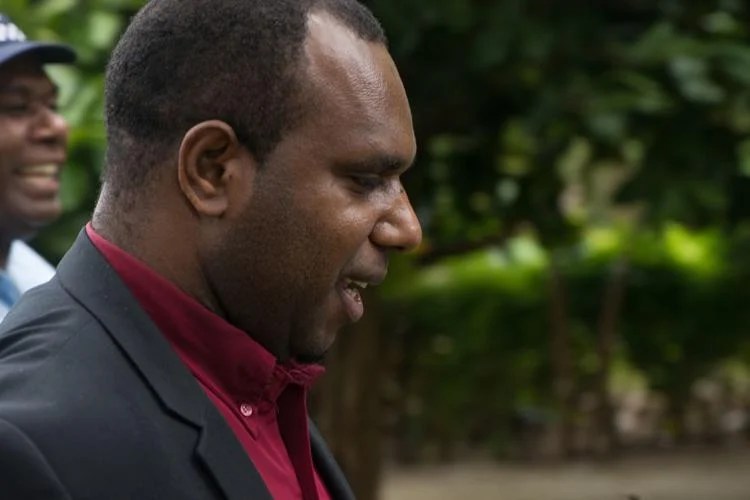
In a written statement sent to the Daily Post yesterday, Minister of Internal Affairs Andrew Napuat thanked the Australian Defence Forces for their generous donation of material and personnel support during Exercise Australian Alliance, a two-week training exercise that culminated this week in a training exercise simulating disaster response and security operations in the wake of fictional cyclone Mick.
This was Mr Napuat’s first time witnessing the annual exercise. Yesterday he told the Daily Post, “I have briefly expressed [my impressions] to the force members and will give a detailed comment on this later during my briefings with them.”
The Minister was supportive of the effort, and quick to applaud the professionalism and engagement of the Australian Army, Navy and Air Force personnel.
He suggested that in the future, it might be more useful to better integrate members of the community into the exercise. The Daily Post asked several villagers in Paonangisu, where a part of the exercise took place, whether they had been told anything about what was happening around them. No one the newspaper talked to was aware of the plan.
Mr Napuat suggested that village authorities need to be an integral component in any security operation. “What was missing yesterday is contextualisation and localisation of the exercise…. In most communities if not all, the chiefs and their people have always participated in combating crime…. For instance if there were two rapists in the community, if the chiefs knew that Police were coming, they would have already arrested the culprits and have them ready for the police to come and take them to face justice”.
He added, “I would have wanted to see at least a communication strategy, or plan that involves community leaders like the chief or some trustworthy community leaders”.
The exercise has traditionally been an engagement exclusively between Australian Army units and the Vanuatu Mobile Force. This year, for the first time, Police and Maritime Wing detachments also participated. This also marks the first year for elements of the Australian Seventh Brigade to take part. The brigade was recently tasked with security and humanitarian response in the Pacific. Soldiers with the 8/9 Royal Australian Regiment, part of the Seventh, told the Daily Post they had already conducted two similar exercises in other Pacific nations.
Mr Napuat suggested the selection of the 70-person force could have been more carefully considered. He noted in particular the absence of the “Tactical Response Group, who have at all times the first team to attend to crime scenes.”
“If the exercise yesterday was for capacity building of some new people to be trained in that area then OK,” he said. “Otherwise, it should have been the Police who should be the first to respond….”
On a personal note, he said, “The exercise yesterday should have been more of a police exercise than the VMF.”
The Minister reiterated his appreciation of the assistance provided by Australia, but suggested that a greater local planning component might improve results for everyone involved. Rather than running the exercise, he suggested, “it would be in our interest that they give us funding, and we plan our operations according to our context and they should be observers assessing or watching our officers…. In that way after conducting the exercise, they would be in a better position to comment or give feedback rather than actually getting involved in the exercise.”
He was quick to note the value to the ADF participants, however. “In disaster response, we have been getting Australian counterparts (defence) to assist Vanuatu so hopefully they are learning our local approaches in the communities during response”.
This was confirmed by High Commissioner Jenny Da Rin. In a statement yesterday, she wrote, “Exercises like Vanuatu Alliance develop skills and ensure Australia and Vanuatu can work closely together to respond to events like natural disasters in Vanuatu. The ADF 8/9th Royal Australian Regiment personnel learnt a lot from their Vanuatu counterparts and built strong connections.”
The importance of inter-agency cooperation was highlighted last August when ProRescue (then ProMedical Rescue) organised a six-week inter-agency skills development workshop that included several practical exercises, including disaster response. Many participants were enthusiastic about having the opportunity to network, to put faces to names, to better assess their colleagues’ capabilities, and to reduce or remove rivalries.
In small countries like Vanuatu, people are often required to work outside their core competence. VMF and ADF members collaborated ad hoc to provide security on one or two occasions during the cyclone Pam response.
Napuat was optimistic about the prospects for benefiting from training like this when, not if, disaster strikes again. “In future disasters we hope to see that since they are already familiar jointly planning and executing response strategies, this should assist them to move faster”.
source:Vanuatu daily post
 Andrew Solomon Napuat
Leave a comment